
Research
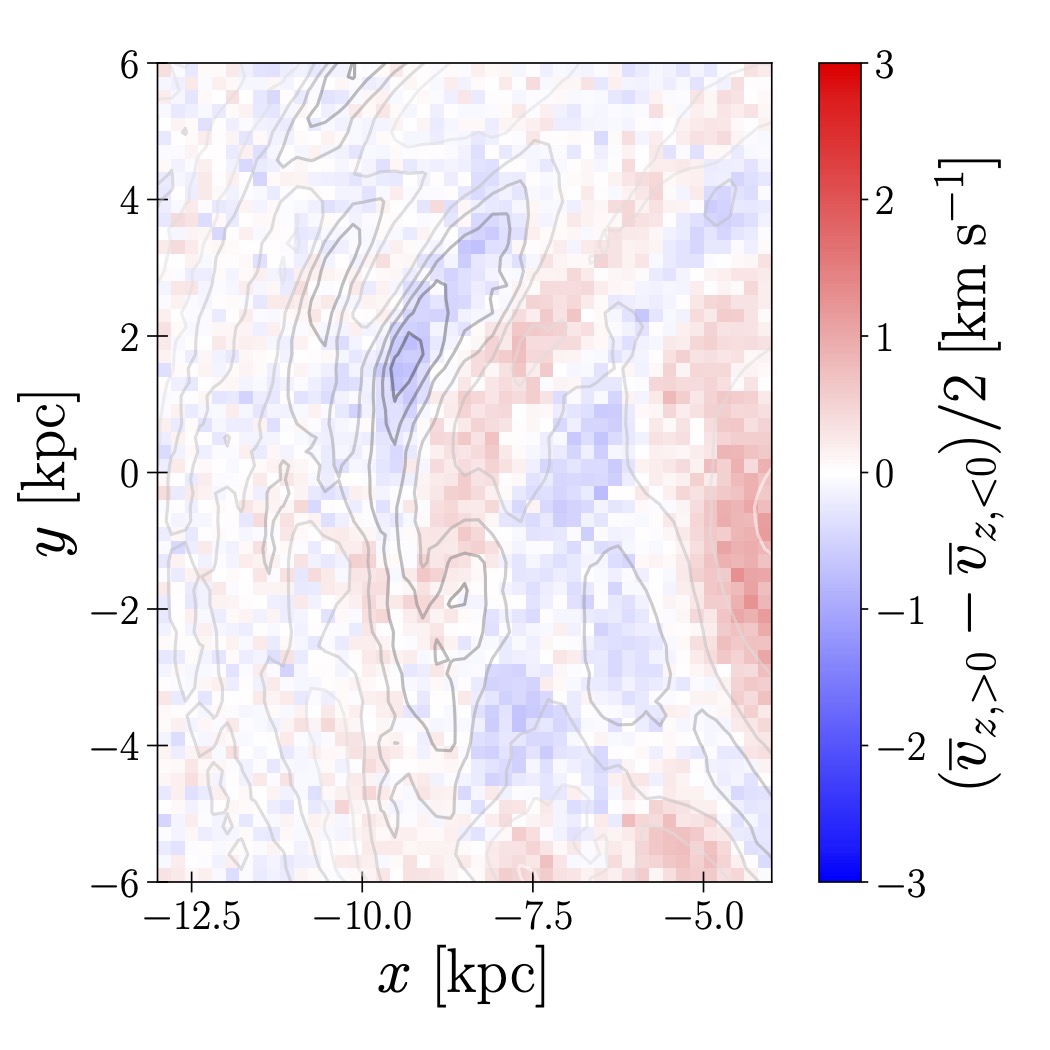
Breathing motion and spiral arms
Gaia DR3 data reveals a distinct pattern of compressing breathing motion a coherent, antisymmetric vertical motion of stars around the Milky Way's mid-plane aligned with the Local arm. Comparison with an N-body simulation suggests that this pattern indicates the Local arm is in a growth phase, while the expanding breathing motion observed near the Perseus arm may indicate it is in a disruption phase. These findings suggest that the Milky Way harbours dynamic spiral arms in various evolutionary phases.
Read more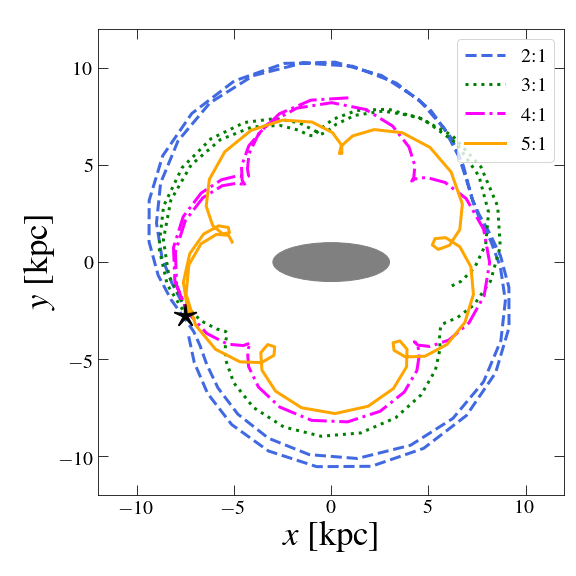
Bar resonances
The Gaia data reveal complex stellar velocity-space structures, such as the Hercules stream, which cannot be explained by axisymmetric models. Using an N-body simulation of a Milky Way-like galaxy, Asano et al. (2020, 2022) demonstrated that these substructures, including the Hercules stream, arise from bar resonances. We employed the Kullback-Leibler divergence to analyse the spatial and temporal variations of velocity-space distributions, finding that Hercules-like substructures are most prominent in specific regions in the bar's rotating frame, highlighting the dynamic influence of bar resonances on the stellar distribution.
Read more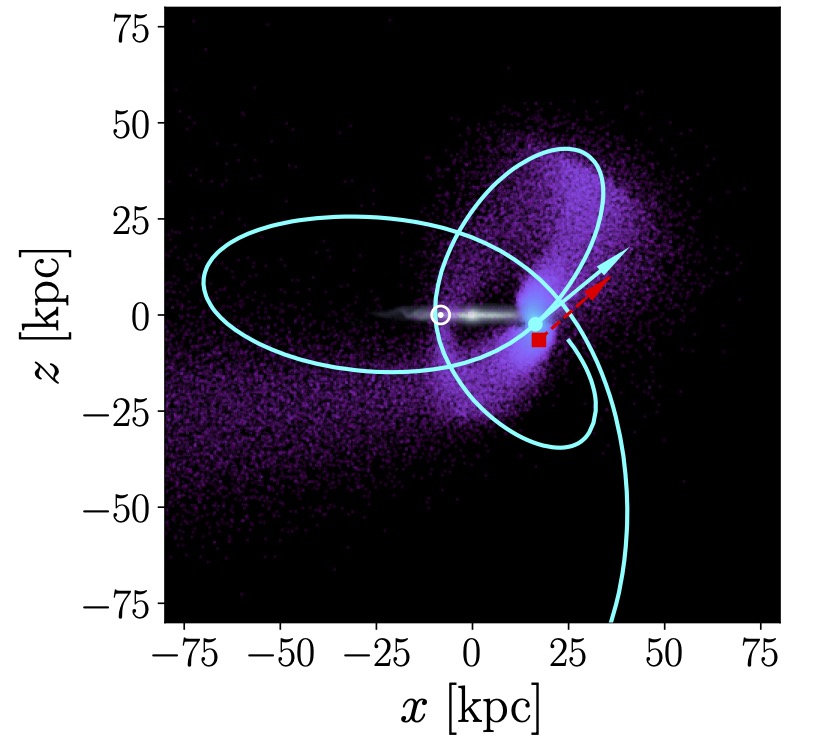
Vertical dynamics in the perturbed Galactic disc
Recent observations from the Gaia mission have revealed non-equilibrium vertical phase-space structures in the Milky Way disk (e.g vertical phase spirals, bending modes, and breathing modes) spurring extensive investigation into past encounters with satellite galaxies. Using high-resolution numerical simulations, we studied how tidal interactions with the Sagittarius dwarf galaxy shape the disc's vertical dynamics through the interplay of direct satellite impacts, internal structures, and disc self-gravity. Asano et al. (2025) demonstrates that direct satellite encounters initially excite bending modes while tidally inducing spiral arms, which indirectly drive longer-lived breathing modes and cause a progressive transition in the dominant vertical oscillation across the disc. Building on this dynamic framework, Asano & Antoja (2026) highlights the critical role of disc self-gravity, showing that it induces a delayed phase-mixing response.
Read more